
Tiktok
Product Design
Search & Sort for Saved Content
Fixing the broken retrieval experience for content TikTok users already intentionally saved.

Role
UX/UI Designer
Team
Solo - just me!
Timeline
4-Week Sprint, 2026
Platform
Mobile/iOS
PROTOTYPE WALKTHROUGH
I started this project with a clear hypothesis: TikTok's Shared Collections feature had a collaboration problem. I assumed that fixing these would deepen engagement and drive user acquisition as people invited others to curate together.
Four weeks later, I'd designed something completely different. The research didn't refine my direction. It replaced it. The real problem was simpler — and more universal. Users couldn't find what they'd already saved.
Prototype walkthrough: From saved to found. Search, sort, and retrieve — across all saved videos and within individual collections.
RESEARCH & INSIGHTS
The audit pointed one way. Users pointed somewhere else.
I audited Shared Collections before any interviews - deliberately. I wanted a concrete hypothesis to test, not a blank slate. Then I ran five moderated remote interviews, recruiting both heavy collection users and non-users. The non-users were a stress test: if collaboration was a genuine need, it should show up everywhere.
It didn't show up anywhere.

*caption*
Free
5/5
Users saved content with genuine intent: recipes, restaurants, travel, product recommendations
Free
0/5
Users could reliably retrieve saved content when they actually need it
Free
3/5
Users built their own workaround to retrieve saved content
That last detail was the pivot. Users don't ask for missing features. They route around the absence. Finding the workaround — and understanding why it existed — pointed to the solution more precisely than any direct question could.
Reframing and pivoting to a new true problem
How might we


BUILDING ON ESTABLISHED MENTAL MODELS
The audit pointed one way. Users pointed somewhere else.
I audited YouTube, Instagram, and Pinterest to understand what mental models users bring before they ever open a TikTok collection.
Two direct design implications, both lessons, shaped every interface decision that followed:
Familiarity beats novelty: designing against established mental models kills adoption.
Restraint is a feature: complexity made Pinterest harder to use, not more useful.

Sort and search feature analysis for Youtube, Pinterest and Instagram
USER FLOW
Search and sort - across all saved videos and within individual collections.
The scope is deliberately contained. Two surfaces, one consistent interaction model.
Dual user flow, two parallel paths. Sort and filter features in 1) all saved videos and 2) within a specific collection
KEY INTERFACE DECISIONS
Four decisions. All research-led.
Every interview participant thought in content keywords first. Every test participant reached for search first. The hierarchy was decided by behaviour, not assumption.


Discovered late in every test session and used as a fallback, not a first instinct. Secondary placement reflects its actual job.
Inside TikTok's existing Manage button, and directly on the collection page. One entry for users who know the pattern. One for users who don't. No re-learning required.

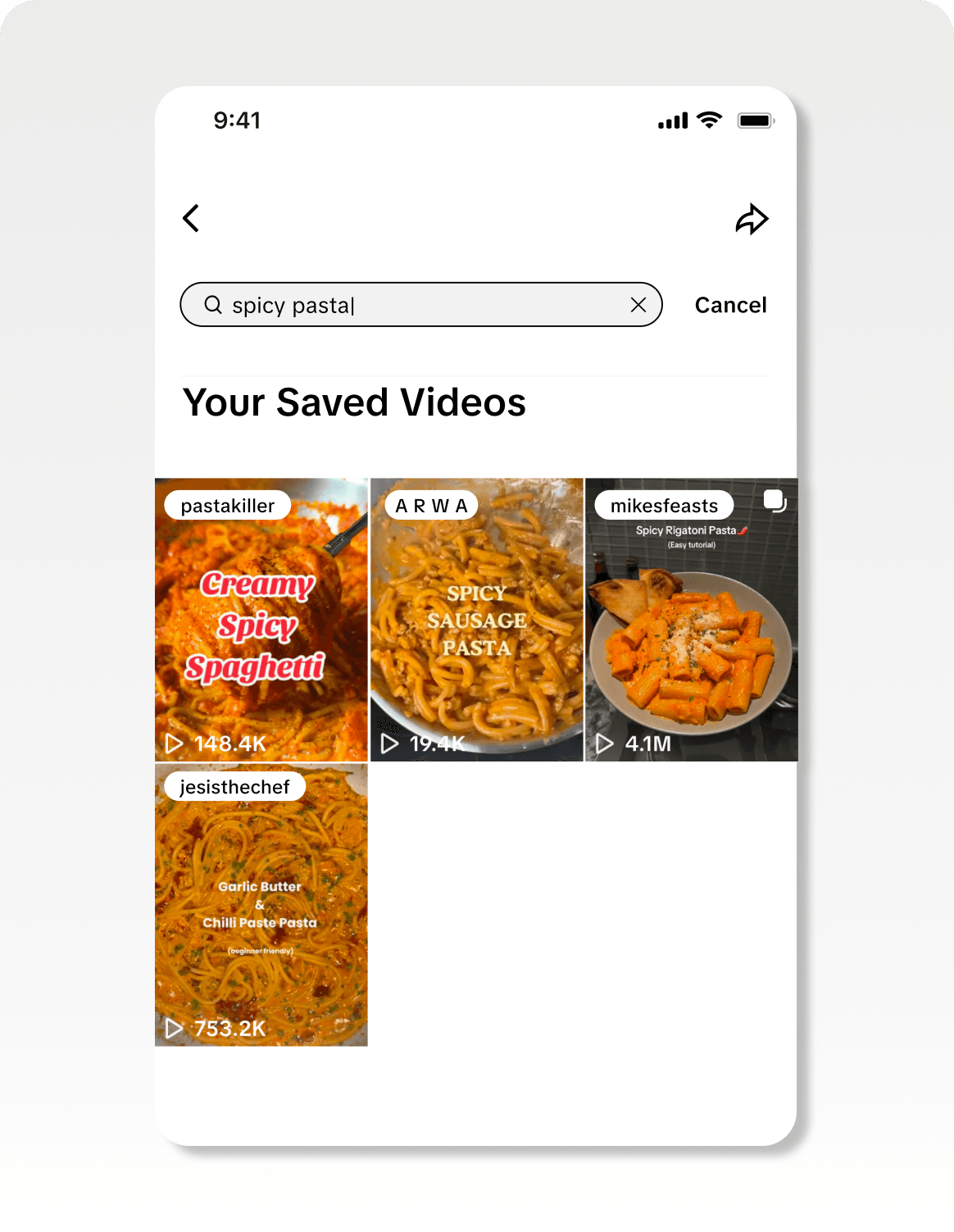
TikTok gives you no creator identifier when scanning saved content. The pill fixes that. Multiple participants called it out unprompted — the highest-value detail in the prototype, at almost zero interface cost.
TESTING
4 participants. Zero failures. One thing that needed fixing.
Every participant reached for search first without prompting. Sort was found late and used as a fallback, exactly as the secondary placement anticipated. The one friction: working with partial information in Task 3 confirmed that search and sort serve different jobs, and users needed both available.
✓ Search: reached for first across every task, every participant
✓ Creator name pills: called out unprompted as the most useful detail in the prototype
✗ Scope label missing: users weren't sure if search covered their collection or all saved videos. Fixed in next iteration.
✗ Creator pill inconsistency: tags weren't rendering consistently across views, contrast too low on some thumbnails


REFLECTIONS
What this project taught me.
Four weeks. A scoped feature brief. Research that invalidated everything I thought I knew going in.
01
ON DESIGNING WITH RESEARCH, NOT AROUND IT
The original hypothesis was wrong. The interviews made that clear in the first session. Pivoting early, before a single screen was designed, meant four weeks building the right thing. Getting it wrong fast is only useful if you're willing to act on it.
02
ON RESTRAINT AS A DESIGN DECISION
Tagging, AI categorisation and cross-collection browsing all came up in research. None of them made it in. Competitor analysis showed exactly what happens to utility features built without restraint — they become complex, secondary, and invisible. Saying no to scope is a skill.
03
ON THE DETAIL THAT EARNS TRUST
Creator name pills were a small decision. They took almost no interface space. Every participant called them out unprompted. The highest-value moment in the prototype wasn't the feature - it was a label. Small details don't just polish a design. Sometimes they are the design.